
By Robert Johnson September 1, 2026
Capturing a customer’s card weeks or months before a preorder is ready can create unnecessary refunds, customer complaints, accounting complexity, and cash-flow confusion.
Yet simply authorizing the original order and waiting indefinitely creates a different problem: card authorizations are temporary, and the original approval may no longer be usable when fulfillment finally begins.
A reliable authorization only ecommerce workflow therefore has to coordinate payment state with order and fulfillment state.
The merchant needs to know not only whether the customer placed the preorder, but whether the payment is authorized, whether that authorization remains eligible for capture, whether the amount has changed, whether a new authorization is required, and whether captured funds actually settled.
The most important principle is simple:
Authorization reserves or verifies available credit or funds according to issuer and network rules; capture initiates the process of collecting the authorized amount. They are separate stages, and an approved authorization should never be treated as completed payment.
That distinction becomes especially important with ecommerce preorders because three independent clocks may be running at once:
- the expected fulfillment date;
- the authorization or capture-eligibility period;
- the customer’s expectations about when money will actually be collected.
The merchant’s system must keep these clocks synchronized without pretending they are the same thing.
Order Status ≠ Authorization Status ≠ Capture Status ≠ Settlement Status.
A preorder can be confirmed while payment is merely authorized. An authorization can be approved while capture later fails. A capture can be accepted by the gateway while final settlement is still pending.
This guide explains how to design those distinctions into checkout, fulfillment, gateway APIs, customer communication, finance reporting, and exception management.
What Is Authorization-Only Ecommerce?
An authorization-only transaction is a payment flow in which the merchant asks the issuer to approve a transaction amount but does not immediately submit that transaction for capture and settlement.
In a typical card-not-present checkout, the gateway or processor sends an authorization request through the acquiring and card-network infrastructure to the card issuer. If the issuer approves it, the merchant receives an authorization response and associated transaction identifiers.
Depending on the issuer, network, transaction type, and account, that authorization may also appear to the customer as a pending credit card authorization hold that reduces available credit or available funds temporarily.
What it does not mean is that the merchant has received the money.
An authorization-only transaction can:
- validate that the credential can presently be used for the requested transaction;
- request issuer approval for a specified amount;
- potentially cause an issuer-determined pending hold;
- return an authorization code or reference;
- create a transaction that may later be captured, if it remains eligible.
It does not automatically create a settled bank deposit.
This is why ecommerce applications should maintain separate fields such as:
- order_status = preorder_confirmed
- payment_status = authorized
- fulfillment_status = awaiting_inventory
rather than collapsing all three into a misleading state called paid.
For additional background on the technology connecting an online store to processors and financial institutions, see this explanation of the role of a payment gateway in ecommerce.
Authorization vs. Capture: The Difference Every Preorder Workflow Must Preserve

The direct answer is:
Authorization asks whether the transaction can be approved. Capture tells the processor to move an approved transaction toward clearing, settlement, and merchant funding.
Those steps may occur seconds apart in ordinary ecommerce, which is why businesses sometimes think of them as one transaction. With delayed capture payments, however, separating them becomes an operational requirement.
| Stage | What Happens | Customer Impact | Merchant Accounting Impact |
| Authorization | Issuer evaluates the payment request | May appear as a pending hold | Not a bank deposit or settled payment |
| Capture | Merchant submits an approved transaction for collection | Transaction begins moving toward posting | Captured payment becomes relevant to processor receivables/reconciliation |
| Settlement | Transaction clears and funding processes | Charge generally moves toward or becomes posted | Merchant reconciles processor settlement and bank funding |
| Refund | Merchant returns a previously captured payment | Credit is processed back toward customer | Refund must be matched against prior captured payment |
This difference is central to preorder credit card processing.
Suppose a merchant accepts a $180 preorder scheduled to ship in two weeks. The customer completes checkout and the issuer approves a $180 authorization.
The order might now show:
Order: Confirmed
Authorization: Approved for $180
Capture: Not submitted
Settlement: None
Fulfillment: Awaiting inventory
Nothing in the authorization approval itself means that $180 has settled to the merchant.
Authorization Is Not Payment Settlement
An authorization tells the merchant what the issuer decided at that particular authorization event. It does not guarantee a successful future capture or settlement.
Several things can happen between authorization and fulfillment:
- the authorization can age beyond an applicable processing window;
- the account can be closed or restricted;
- the credential can change;
- the final amount can change;
- the authorization can be reversed;
- a capture request can contain incorrect data;
- issuer or network processing can reject subsequent activity;
- the gateway can report a capture failure;
- the capture can encounter a technical problem requiring status verification.
Visa specifically recognizes reauthorization scenarios involving delayed and split ecommerce shipments when fulfillment extends beyond authorization-validity limits.
For that reason:
Authorization Approved ≠ Future Capture Guaranteed ≠ Settlement Guaranteed.
That principle should be represented in both application logic and employee training.
Immediate Capture vs. Delayed Capture for Preorders

Immediate capture and delayed payment capture are both legitimate payment architectures. The correct approach depends on the merchant’s product, fulfillment timing, customer disclosures, processor configuration, and applicable network and legal requirements.
Immediate Capture
Immediate capture generally means that authorization and capture happen together or in rapid succession.
It can make sense when merchandise is ready for prompt fulfillment, where the merchant’s sales terms support immediate collection, or where the payment method does not support separate authorization and capture.
Its operational advantage is simplicity. The merchant does not have to maintain an inventory of uncaptured authorizations or manage authorization aging.
But for a preorder that might not ship for weeks, capturing immediately can produce downstream work. A cancellation after capture generally requires a refund rather than simply releasing an unused authorization.
Delayed Capture
With delayed capture, the merchant authorizes first and captures after a later business event.
A provider such as Adyen, for example, documents separate automatic, delayed automatic, and manual capture options for payment methods that support separate capture. Its manual-capture documentation specifically describes fulfillment and shipment as possible capture points while making clear that the capability varies by payment method.
That approach can align collection more closely with fulfillment.
It does not mean delayed capture is automatically preferable for every preorder. A three-day preorder and a six-month custom manufacturing order create very different authorization-lifecycle problems.
Why Preorders Create an Authorization Timing Problem
A preorder asks the payment system to bridge two events that may occur far apart:
purchase intent today and fulfillment later.
The merchant wants reasonable confidence that the customer can pay. The customer may reasonably expect not to see a final posted charge until the merchant reaches the disclosed collection point.
Meanwhile, payment networks and issuers do not keep ordinary authorizations open forever.
That creates an unavoidable timing equation:
Time Until Fulfillment vs. Remaining Capture Eligibility
If expected fulfillment occurs comfortably within the applicable authorization rules and processor implementation, authorize-then-capture may be practical.
If fulfillment will occur well beyond that window, the merchant needs another strategy.
The exact authorization-validity period must not be hard-coded based on an internet rule of thumb. Current Visa documentation, for example, provides transaction-specific processing timeframes and directs merchants to their acquirers for the complete rules applicable to transaction type and approval-response validity.
Visa lists a 10-day maximum transaction-processing timeframe for certain cardholder-initiated card-absent-estimated-authorization scenarios, but that is a Visa-specific rule for the specified transaction category—not a universal “all ecommerce authorizations last ten days” rule. Other networks, transaction classifications, gateway configurations, and issuer behavior can differ.
This is precisely why preorder payment systems need authorization lifecycle management rather than a single countdown constant.
A Better Preorder Payment State Machine
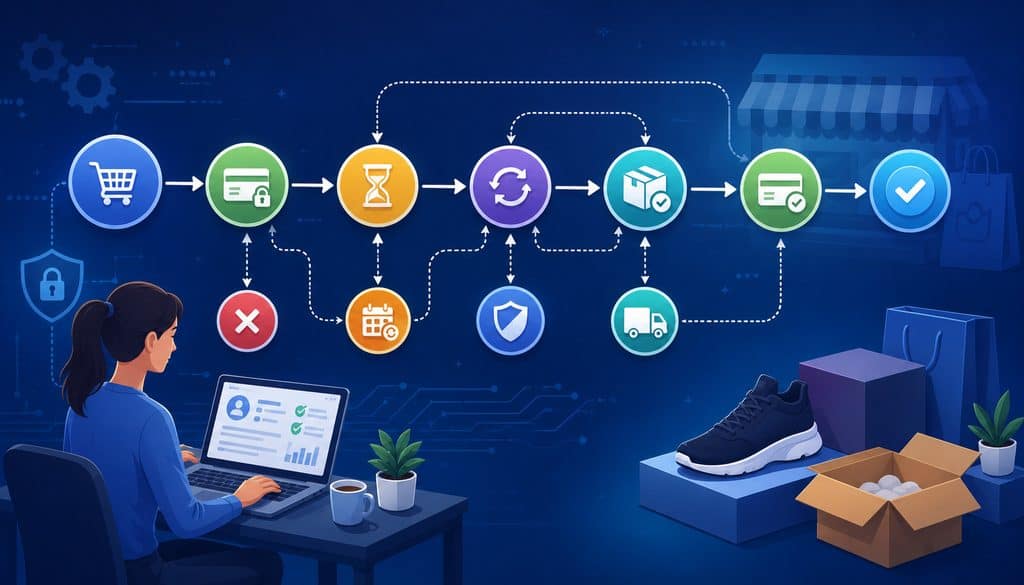
A reliable ecommerce payment workflow should maintain an explicit state machine rather than relying on scattered boolean fields such as paid=true.
A useful normal path is:
Order Created → Authorization Attempted → Authorized → Awaiting Fulfillment → Capture Eligible / Reauthorization Needed → Captured → Shipped → Settled
Exception states should include:
- authorization declined;
- authorization expired;
- authorization reversed;
- customer canceled;
- capture failed;
- capture status unknown;
- partial shipment;
- partially captured;
- payment update required;
- refund pending;
- refunded.
The same order can have different payment and fulfillment states simultaneously.
| Order State | Payment State | Allowed Next Action |
| Preordered | Authorized | Monitor fulfillment and authorization |
| Awaiting inventory | Authorization aging | Review capture eligibility |
| Ready to ship | Valid authorization | Capture according to provider rules |
| Ready to ship | Expired/invalid authorization | Seek fresh authorization |
| Canceled | Authorized only | Reverse/void unused authorization |
| Canceled | Captured | Process refund as appropriate |
This model prevents one of the most dangerous preorder assumptions: that an order marked “confirmed” is necessarily safe to ship.
How Long Can a Payment Authorization Remain Valid?
There is no single authorization-validity period that applies to every ecommerce preorder.
Authorization and processing timeframes can depend on:
- card network;
- transaction classification;
- merchant category;
- card-present versus card-not-present environment;
- whether an authorization is final or estimated;
- eligibility for incremental authorization;
- regional rules;
- gateway and processor implementation;
- acquirer configuration;
- issuer behavior.
Visa’s Authorization and Reversal Processing Requirements for Merchants illustrates why merchants should verify transaction-specific authorization timeframes instead of relying on a universal capture window.
Visa’s current merchant guidance illustrates why specificity matters. Its authorization and reversal guide lists different maximum processing timeframes for categories including lodging, rentals, cardholder-initiated card-absent transactions, and card-present transactions, and tells merchants to work with their acquirer for the applicable requirements.
Adyen provides another useful example of the difference between a payment provider’s operational configuration and network rules.
Its documentation states that it automatically expires certain global-card-scheme preauthorizations after its configured period while separately warning that card schemes maintain their own validity rules and that capturing after scheme-side expiration can increase failure risk.
Those are provider-specific facts, not universal ecommerce rules.
Authorization Hold vs. Authorization Validity
A customer-visible pending hold should not automatically be treated as proof that an authorization remains capturable.
Likewise, disappearance of a pending amount from the customer’s banking interface does not tell the merchant, by itself, exactly what the gateway or card network will allow.
Two distinct questions exist:
- What does the issuer display to the customer?
- Is the transaction still eligible for capture under the applicable processing rules?
The merchant’s application should answer the second question using gateway, processor, acquirer, and network information—not screenshots of a customer’s banking app.
Do Not Build a Preorder System Around a “Seven-Day Rule”
A hard-coded authorization_expires_after = 7_days rule is fragile because it assumes all cards, networks, merchant categories, payment providers, and transaction types behave alike.
Instead, obtain the applicable information from your provider.
Record at least:
- authorization timestamp;
- provider payment ID;
- authorization ID;
- network transaction/reference ID where exposed;
- authorized amount;
- currency;
- authorization type;
- gateway status;
- capture-eligibility or expiration information where available;
- expected fulfillment date.
Then compare fulfillment timing with provider-reported eligibility.
An authorization-aging report might look like this:
| Order | Authorization Date | Amount | Fulfillment ETA | Auth Status | Action Needed |
| P-1042 | Day 0 | $149 | Soon | Valid per gateway | Monitor |
| P-1048 | Day 0 | $279 | Later | Review required | Verify provider window |
| P-1051 | Earlier | $89 | Ready | Expired/invalid | Reauthorize |
Never place the full PAN or CVV in such reporting.
Short Preorders and Long-Lead Preorders Need Different Strategies
A product expected to ship several days after checkout may be a reasonable candidate for authorize then capture, provided the merchant has confirmed the applicable authorization rules and provider capabilities.
A collectible being manufactured for delivery several months later is a fundamentally different payment problem.
Trying to keep one ordinary authorization alive for an extended preorder can result in repeated holds, expired authorizations, confused customers, and brittle gateway logic.
For long lead times, possible architectures include:
- tokenize the payment method at checkout and authorize closer to fulfillment;
- reauthorize when required under the supported payment framework;
- collect a disclosed deposit and process the balance later where appropriate;
- request payment closer to fulfillment.
The point is not that one option is universally best. The point is that a long preorder needs an explicit payment lifecycle rather than an indefinitely aging authorization.
Tokenize Now, Authorize Later
A common architecture for long-lead orders is:
Customer Checkout → Provider Tokenizes Credential → Merchant Stores Payment Token/Reference → Order Waits → Fresh Authorization Near Fulfillment → Capture → Ship
Tokenization replaces sensitive payment information with a substitute credential or payment reference. EMVCo explains that EMV Payment Tokenisation replaces the PAN with a token constrained to a particular use context, helping reduce the value of exposed payment information.
For additional background, Host Merchant Services explains how payment tokenization works, including how a merchant can retain a token that references securely stored payment information rather than keeping card numbers directly in ordinary business systems.
Tokenization does not give a merchant unrestricted authority to charge a card later. Stored-credential requirements, customer agreements, transaction indicators, and the distinction between customer-initiated and merchant-initiated transactions still matter.
Visa’s current public rules, for example, contain specific requirements governing stored credentials, initial authorization or account verification, and the indicators used for subsequent credential-on-file transactions.
Customer disclosures should explain:
- whether a preorder authorization will be attempted;
- whether the customer could see a temporary pending hold;
- when final collection is expected;
- what happens if the payment method needs to be reauthorized;
- how price, shipping, tax, or quantity changes are handled;
- the cancellation and partial-shipment policy.
When Should a Merchant Reauthorize Instead of Capture?
A merchant should consider a fresh authorization when the original authorization is no longer valid or appropriate for the intended capture.
Common triggers include:
- the provider reports that the original authorization expired;
- fulfillment occurred outside the applicable processing window;
- the authorization was reversed;
- the payment provider says the transaction is no longer eligible for capture;
- the amount changed in a way the original authorization does not cover;
- applicable network or processor rules require another authorization.
Visa explicitly defines reauthorization as relevant when fulfillment extends beyond the applicable authorization-validity limit and specifically identifies delayed or split ecommerce shipment scenarios.
Reauthorization vs. Repeated Authorization Holds
Reauthorization should solve a real payment-lifecycle need. It should not become a mechanism for continuously placing unnecessary overlapping holds on a customer’s account.
If the original authorization will not be used, the merchant should determine whether an authorization reversal is required or supported before creating another authorization.
Visa’s merchant guidance stresses authorization reversals when approved authorizations will not be completed and explains that proper reversals help maintain transaction integrity.
A preorder system should therefore preserve links among:
Original Authorization → Reversal, if applicable → New Authorization → Capture
That audit trail is valuable to finance, customer support, risk, and dispute teams.
Authorization Reversal, Void, Refund, and Expiration Are Different
These terms are often blurred by merchant dashboards, but the underlying concepts are not interchangeable.
An authorization reversal is a message or process intended to cancel or reduce an authorization that will not be captured, subject to network, processor, and issuer processing.
A void is frequently a provider-facing term for canceling a transaction before settlement. Depending on the processor and transaction state, the underlying payment processing may involve an authorization reversal.
A refund returns money after a transaction has been captured or settled.
An expired authorization means the prior authorization aged beyond the applicable state or eligibility. Expiration is not a refund.
| Action | Before/After Capture? | Funds Settled? | Typical Purpose |
| Authorization reversal/void | Usually before settlement | No | Release/cancel unused authorization |
| Capture | After authorization | Not yet necessarily settled | Move approved transaction toward clearing |
| Refund | After capture | Payment was collected or being processed | Return collected amount |
Some payment platforms expose their own terminology, so merchants should map provider labels into an internal normalized state model.
Cancellation Before Capture
For an authorization-only preorder, cancellation can follow:
Customer Cancels → Stop Fulfillment → Verify Payment State → Cancel/Void and Reverse as Required or Supported → Update Order → Confirm No Capture
If nothing was captured, there ordinarily is no captured payment to refund.
That is operationally different from:
Payment Captured → Customer Cancels → Refund Captured Payment
Reversals also matter to the customer experience because an unused authorization should not simply remain outstanding unnecessarily. However, merchants should not guarantee that a customer’s bank will remove a visible pending hold within a specific number of hours or days; issuer processing and display behavior can vary.
What Happens When an Authorization Expires?
The direct answer is:
Do not treat an expired authorization as permission to capture. Determine whether a new authorization is required under your network, processor, gateway, and customer-payment framework.
An expired authorization should create a deliberate exception state rather than silently falling through to capture.
A practical workflow is:
- Mark the original authorization as expired or no longer capture-eligible.
- Prevent an automated stale capture.
- Check whether the order is ready for fulfillment.
- Verify the stored credential and customer authorization framework.
- Request a fresh authorization when appropriate.
- Handle any issuer decline.
- Capture only after receiving a valid approval.
- Preserve references for the original and replacement authorization.
Expiration does not mean a refund took place.
If no capture occurred, there may be no merchant funds to refund even though the customer previously saw a temporary authorization hold.
When Reauthorization Is Declined
A new authorization may fail because:
- available funds or credit changed;
- the issuer declines the payment;
- the account was closed;
- the credential was replaced;
- the customer must update the payment method;
- another payment restriction applies.
Do not blindly retry issuer declines.
Instead:
Reauthorization Fails → Classify Decline → Notify Customer if Action Is Needed → Securely Update Payment Method → Retry Under Appropriate Provider/Network Rules → Cancel or Release Inventory if Unresolved
Never ask customers to email their complete card number or CVV.
Changed Preorder Totals: Lower, Higher, or Different
A preorder amount is not always fixed.
Sales tax can change, the customer may upgrade shipping, a backordered item may be removed, or the customer may add another product.
Every material order change should therefore trigger payment-state validation.
| Scenario | Original Auth | Final Amount | Potential Action |
| Final total unchanged | $200 | $200 | Capture if authorization remains valid |
| Final total lower | $200 | $175 | Partial capture if supported; handle unused amount properly |
| Final total higher | $200 | $225 | Obtain appropriate additional/fresh authorization |
| Item canceled | $200 | $140 | Capture reduced amount if supported; address remainder |
| Additional item added | $200 | $260 | Do not assume original authorization covers increase |
Final Amount Lower Than the Authorization
Some gateways support capturing less than the amount originally authorized.
For example, Adyen documents single and multiple partial capture models for supported payment methods. Under its single-partial-capture model, remaining uncaptured value is canceled; multiple partial capture behaves differently and requires specific enablement.
That example reinforces an important point:
Partial capture behavior is provider-specific.
Your application should know what happens to the unclaimed authorization balance rather than assuming it remains available.
Final Amount Higher Than the Authorization
Do not assume a merchant can simply capture more than originally authorized.
Depending on the transaction, possible options may include:
- a new authorization;
- an additional authorization supported by the provider;
- an authorization adjustment;
- an eligible incremental authorization;
- renewed customer approval.
Incremental authorization is especially easy to misuse conceptually. Visa and payment-provider rules provide incremental or estimated-authorization functionality for particular transaction models and merchant categories; it should not be treated as a universal ecommerce tool for increasing ordinary preorder charges.
Adyen, for example, explicitly states that authorization-adjustment availability is limited by payment method and merchant category and ultimately depends on issuer support.
Do not copy hotel, vehicle-rental, or cruise authorization procedures into a generic online retail preorder flow merely because those industries commonly use estimated and incremental authorization.
Partial Shipments and Multiple Captures
A preorder can generate several fulfillment events:
One Order → Shipment A → Shipment B → Shipment C
That creates a payment-design question: should the merchant capture the whole order at once, capture each shipment individually, or use separate authorization transactions?
Possible architectures include:
- capture only when the complete order is ready;
- perform partial captures for individual shipments where supported;
- perform multiple partial captures where explicitly supported;
- create separate authorizations tied to separate fulfillment events.
There is no universal answer.
Partial Capture vs. Multiple Capture
A partial capture means:
Authorized Amount → Capture Less Than the Full Amount
A multiple-capture capability generally means more than one capture can be associated with an original authorization or preauthorization under the provider/network-supported model.
Do not assume the remaining amount is automatically available after a partial capture.
Adyen’s documentation demonstrates why merchants need to ask explicitly. It distinguishes single partial capture—where unused value may be canceled—from multiple partial capture, which keeps remaining value available under its supported implementation and must be enabled.
A fulfillment ledger could look like:
| Shipment | Items | Amount | Authorization Reference | Capture Status |
| S1 | Item A | $80 | AUTH-451 | Captured |
| S2 | Item B | $55 | AUTH-451 or new auth | Pending |
| S3 | Item C | $40 | Provider-dependent | Awaiting stock |
The application must also decide what happens to backordered items.
If Shipment A goes now and Shipment B is months away, the merchant may need to capture the available merchandise and later authorize the remaining amount rather than relying indefinitely on the original authorization.
Long-Lead Preorders, Deposits, and Upfront Capture
Delayed capture should not be presented as the only legitimate preorder model.
Made-to-order products, custom manufacturing, deposits, digital goods, or other business models may support earlier collection depending on the sale terms, customer disclosure, applicable law, network requirements, and merchant agreement.
A deposit model could be:
$100 Deposit Captured Today + $400 Balance Authorized/Captured Later
That architecture changes accounting, cancellation, disclosure, dispute, and payment-processing requirements. The deposit should therefore be represented explicitly rather than disguising it as an authorization hold.
What merchants should generally avoid is choosing:
Capture Entire Order Immediately → Wait for Months → Refund Every Cancellation
merely because their payment implementation cannot manage authorization lifecycle.
That approach may increase refund volume, customer support work, and reconciliation complexity. It does not mean delayed capture necessarily costs less or is legally required in every situation.
For U.S. ecommerce merchants selling covered merchandise, the FTC’s Mail, Internet, or Telephone Order Merchandise Rule also requires attention to promised shipping times and customer consent when delays occur.
The FTC explains that sellers generally need a reasonable basis for stated shipment timing and must follow prescribed delay or refund procedures when shipment cannot occur as promised.
Payment architecture and fulfillment obligations therefore need to be designed together.
Authorization-Only Checkout UX and Customer Communication
Checkout wording should accurately reflect what the payment architecture actually does.
If the merchant says:
“You won’t be charged until your order ships.”
then the payment workflow should consistently support that representation.
Customers may nevertheless see a temporary pending authorization after checkout. That possibility should be explained without describing the pending authorization as a settled charge.
Useful checkout disclosures may cover:
- preorder status;
- estimated fulfillment timing;
- when final payment is expected;
- possibility of an authorization hold;
- whether reauthorization may be needed;
- how order changes affect price;
- cancellation terms;
- partial-shipment policy.
A customer may experience:
Checkout → Pending Authorization → Hold Released → Fresh Authorization Later → Final Posted Charge
Support representatives should understand that sequence.
The broader ecommerce experience also matters. Checkout should clearly present fulfillment and payment expectations without creating unnecessary friction; this discussion of checkout experience and customer expectations provides useful background.
Avoid promising that an issuer will remove a hold on a particular date. Merchant action can initiate or transmit the appropriate reversal, but issuer presentation timing can vary.
Tokenization, Stored Credentials, and PCI DSS
Authorization-only processing does not reduce PCI DSS scope by itself.
PCI scope depends on how payment-card data enters, moves through, and is stored in the ecommerce environment.
The PCI Security Standards Council explains that card-not-present environments such as ecommerce have payment-data channels that must be assessed and protected, and that even technologies designed to reduce exposure do not automatically eliminate PCI applicability.
A common approach is to let a compliant payment provider handle card entry and tokenization so normal merchant business systems retain a payment token or provider reference instead of unnecessary raw PAN data.
Never Store CVV for Later Reauthorization
This rule is especially important for preorders:
Do not retain CVV so that you can reauthorize the card weeks later.
PCI SSC explicitly states that card verification codes are sensitive authentication data and cannot be stored after authorization, even if encrypted.
A long-term preorder therefore needs a compliant stored-credential or token architecture—not a database field containing the customer’s CVV.
Reasonable non-sensitive fields to retain can include:
- merchant order ID;
- customer reference;
- provider payment ID;
- payment token;
- authorization ID;
- network reference where available;
- authorized amount;
- authorization timestamp;
- payment status;
- capture ID;
- settlement ID.
Never build delayed capture by retaining prohibited authentication data.
Gateway Controls Required for Delayed Capture Payments
A preorder payment workflow is only as reliable as the gateway controls behind it.
Before adopting manual capture ecommerce, determine whether the provider clearly supports the features your fulfillment model requires.
| Capability | Required? | Provider Supports? | Limitations |
| Authorization-only | Usually | Verify | Payment-method differences |
| Delayed/manual capture | Usually | Verify | Capture windows |
| Authorization expiration visibility | Highly useful | Verify | May be provider-specific |
| Reauthorization | Required for aging flows | Verify | Stored-credential rules |
| Partial capture | If totals may decrease | Verify | Remaining auth behavior |
| Multiple capture | If split shipment requires it | Verify | May need enablement |
| Authorization reversal | Yes | Verify | Provider terminology |
| Tokenization | Long-lead orders | Verify | Token lifecycle |
| Webhooks | Strongly recommended | Verify | Event coverage |
| Idempotency | Strongly recommended | Verify | Endpoint-specific |
| Settlement IDs | Yes for reconciliation | Verify | Reporting/API availability |
A merchant should also determine whether the gateway can surface:
- authorization timestamp;
- authorization reference;
- card-network reference;
- capture eligibility;
- partial-capture status;
- reversal status;
- capture failure reason;
- settlement identifiers.
A gateway’s feature checklist matters more than a generic claim that it supports “preorders.”
Manual Capture Permissions
Manual capture should not mean that any employee who can log into a gateway dashboard can collect any authorized transaction.
Separate permissions for:
- viewing authorizations;
- capturing payments;
- reversing or voiding;
- issuing refunds;
- modifying gateway configuration.
The preferred capture trigger is often an approved business event:
Warehouse Marks Ready to Ship → Payment Service Validates Authorization → Capture Submitted → Capture Confirmed → Shipment Released
A calendar date alone is usually a poor trigger because the inventory may not actually be ready.
Webhooks, Idempotency, and Duplicate Capture Prevention
Delayed capture introduces asynchronous payment events, which means integrations need to handle uncertainty correctly.
The browser is not authoritative payment state.
A customer seeing “Processing…” and refreshing the checkout page should never generate another capture because the application failed to receive an immediate response.
Use gateway/API state and verified server-side webhooks.
Payment webhooks may report events such as:
- authorization created;
- authorization adjusted;
- capture succeeded;
- capture failed;
- authorization canceled or expired;
- refund completed.
Actual event names differ by provider.
Adyen, for example, documents CAPTURE and CAPTURE_FAILED webhook events in its authorization-adjustment and capture workflows.
Idempotency and Unknown Capture Status
Capture requests should use provider-supported idempotency mechanisms when available.
Track:
- order ID;
- authorization ID;
- requested capture amount;
- capture request ID;
- provider capture ID;
- current state.
Most importantly:
Timeout ≠ Capture Failed.
Suppose the merchant sends a $175 capture and the HTTP connection times out.
The wrong response is:
“We did not see success, so send another $175 capture.”
The correct flow is:
Capture Request → Timeout/Unknown Result → Query Authoritative Gateway Status → Process Existing Capture if Found → Retry Only Under Provider-Safe Rules
This avoids turning network uncertainty into duplicate billing.
Payment Reporting and Authorization Aging
Finance and operations should be able to distinguish every material payment state without reading raw gateway logs.
At minimum, reporting should separate:
- authorized;
- authorized but uncaptured;
- partially captured;
- captured;
- expired;
- reversed;
- capture failed;
- capture status unknown;
- refunded.
An authorization-aging dashboard might contain:
| Order | Authorized Amount | Auth Status | Expected Ship Date | Capture Eligibility | Next Action |
| P-201 | $120 | Authorized | Soon | Valid | Wait |
| P-202 | $260 | Aging | Later | Review | Verify/re-authorize |
| P-203 | $75 | Expired | Ready | Not eligible | Fresh authorization |
| P-204 | $310 | Authorized | Canceled | Unused | Reverse |
Do not calculate “capture deadline” from a guessed universal number if your provider exposes authoritative status.
Exception Reporting
Exception reports should combine fulfillment and payment states.
| Order | Payment Status | Fulfillment Status | Exception | Owner | Action |
| P-311 | Aging auth | Awaiting stock | ETA beyond eligibility | Payments | Review |
| P-318 | Capture failed | Ready to ship | Payment unresolved | Operations | Hold shipment |
| P-326 | Authorized $200 | Final $225 | Amount exceeds auth | Payments | Fresh/additional auth |
| P-331 | Authorized | Canceled | Unused authorization | Support | Reverse |
| P-339 | Unknown capture | Ready | Duplicate risk | Engineering | Query gateway |
This dashboard is where the principle becomes operational:
Order Status ≠ Authorization Status ≠ Capture Status ≠ Settlement Status.
Reconciliation: Authorization → Capture → Settlement → Bank Deposit
Authorization values should never be treated as bank deposits.
The reconciliation chain is:
Order → Authorization → Capture → Settlement → Bank Deposit
Finance should separately report:
Authorized Orders
Captured Card Sales
Settled/Funded Transactions
A useful reconciliation key set includes:
- merchant order ID;
- gateway payment ID;
- authorization ID;
- capture ID;
- captured amount;
- settlement batch or settlement ID;
- funding/deposit reference.
For example, 500 preorders totaling $80,000 may be authorized in the commerce platform while only $12,000 has been captured for orders actually ready to ship.
Reporting $80,000 as captured card sales would distort payment operations.
Accounting treatment also depends on applicable accounting rules and the facts of the sale. An authorization alone should not automatically be assumed to create cash, processor funding, or recognized revenue.
Refunds vs. Unused Authorizations
The operational rule is:
No Capture → Generally No Captured Payment to Refund
If a customer cancels before capture, investigate whether the correct action is reversal, void, or letting an authorization expire under the provider’s supported process.
If the preorder was already captured, cancellation may require an actual refund.
That distinction reduces confusing reports where “refunds” are recorded against transactions from which the merchant never collected money.
Fraud Controls for Delayed Fulfillment
Delayed capture does not eliminate ecommerce fraud risk.
In some cases, a long period between checkout and shipment makes a second risk review sensible because circumstances surrounding the order may have changed.
Potential signals include:
- shipping-address changes;
- account takeover indicators;
- unusual order edits;
- large quantity increases;
- payment-method changes;
- unusually long fulfillment delays.
Security controls should remain defensive and proportionate.
A merchant can review this overview of online fraud prevention for merchants for related card-not-present risk considerations.
Authentication technologies such as EMV 3-D Secure should also remain conceptually separate from the payment lifecycle:
Authentication ≠ Authorization ≠ Capture.
AVS, CVV checks, authentication results, and fraud scoring can contribute to risk decisions, but none guarantees successful future capture.
And again, CVV must not be stored for future authorization.
Saved Credentials, Account Updates, and Network Tokens
A customer’s payment credential can change during a long preorder.
The physical card may be replaced, its printed expiration date may change, or the underlying account may be updated.
Depending on the processor, network, token type, and issuer participation, account updater or network-token lifecycle services may help maintain eligible stored credentials.
Network tokens are particularly relevant because their lifecycle can sometimes be managed independently of the PAN presented at the original checkout. EMVCo’s payment-tokenisation framework explains how tokens substitute for PANs and can be constrained to particular merchants, devices, or payment scenarios.
Do not assume:
Printed Card Expired → Stored Credential Definitely Unusable
or the opposite:
Stored Token Exists → Future Authorization Guaranteed
The merchant should rely on the provider’s supported token lifecycle and authorization result.
Preorder Operational Workflow
A robust implementation can follow this sequence:
- Customer places the preorder.
- Create the merchant order.
- Tokenize the payment method through the payment provider.
- Request authorization-only if that model is appropriate.
- Record authorization metadata.
- Maintain payment, order, and fulfillment states separately.
- Monitor expected fulfillment and authorization eligibility.
- Reverse unused authorization if the order is canceled where applicable.
- When inventory becomes ready, validate final total.
- Confirm whether the original authorization remains capture-eligible.
- Reauthorize when a fresh authorization is required.
- Submit capture using duplicate-protection controls.
- Confirm capture outcome before releasing fulfillment when appropriate.
- Ship the merchandise.
- Reconcile capture to settlement and funding.
- Preserve the complete audit trail.
For long-lead preorders, consider a different architecture:
Tokenize at Order → Do Not Depend on Months-Old Authorization → Authorize Near Fulfillment → Capture → Ship
That flow remains subject to provider functionality, stored-credential rules, customer consent, and applicable network requirements.
Decision Matrix for Preorder Payment Processing
| Preorder Scenario | Potential Payment Approach | Main Risk |
| Ships quickly | Authorization then delayed capture | Authorization may expire |
| Long lead time | Tokenize, authorize closer to fulfillment | Later issuer decline |
| Partial shipments | Partial/multiple capture if supported | Complex reconciliation |
| Price may increase | Fresh/additional authorization as appropriate | Customer consent or decline |
| Final price decreases | Partial capture if supported | Unused authorization balance |
| Custom deposit | Capture deposit + later balance flow | Accounting/disclosure complexity |
The decision should follow provider and network capabilities rather than force every preorder through one pattern.
A merchant selling limited-release shoes that arrive within several days may have a different optimum from a furniture maker promising delivery months later.
Common Authorization-Only Preorder Mistakes
The most common mistakes are less about payment terminology than about missing state management.
Avoid:
- treating authorization as collected payment;
- hard-coding one authorization-validity period;
- assuming a customer-visible hold equals capture eligibility;
- attempting stale capture without checking provider status;
- authorizing months before fulfillment with no lifecycle plan;
- failing to reverse canceled authorizations where appropriate;
- assuming partial capture automatically preserves the remaining amount;
- assuming every gateway supports multiple capture;
- trying to capture more than authorized without checking applicable rules;
- treating incremental authorization as a generic ecommerce tool;
- storing CVV for future reauthorization;
- retrying unknown captures blindly;
- calling authorization expiration a refund;
- letting payment and fulfillment status drift apart;
- shipping only because the original authorization once returned “approved.”
These mistakes share one cause: treating payment as a single state.
A preorder instead needs a transaction history.
Authorization-Only Preorder Checklist
| Area | Verified? |
| Authorization-only supported | ☐ |
| Applicable capture window verified | ☐ |
| Authorization aging tracked | ☐ |
| Tokenization configured | ☐ |
| Stored-credential requirements reviewed | ☐ |
| Reauthorization workflow documented | ☐ |
| Reversal workflow documented | ☐ |
| Partial capture capability confirmed | ☐ |
| Multiple capture confirmed if needed | ☐ |
| Changed-total handling defined | ☐ |
| Cancellation handling defined | ☐ |
| Capture business trigger defined | ☐ |
| Idempotency implemented where supported | ☐ |
| Webhook verification implemented | ☐ |
| PCI DSS scope reviewed | ☐ |
| CVV storage prohibited | ☐ |
| Settlement reporting configured | ☐ |
| Exception reporting configured | ☐ |
| Customer messaging reviewed | ☐ |
Questions to Ask Your Payment Gateway or Processor
Before launching preorder payment processing, obtain specific answers rather than relying on generic sales claims.
Ask:
- How long are our specific ecommerce authorizations eligible for capture?
- Does authorization validity differ by network, transaction type, region, or authorization type?
- Does your API expose authorization expiration or capture eligibility?
- What happens if we submit capture after eligibility expires?
- What is your supported reauthorization process?
- Do you support authorization reversals?
- What provider state corresponds to a void?
- Are partial captures supported?
- What happens to the unused amount after partial capture?
- Are multiple captures supported and must they be enabled?
- Are authorization adjustments or incremental authorizations available for our MCC and transaction model?
- Can we tokenize a credential now and request authorization closer to fulfillment?
- How do you handle stored-credential indicators?
- Is account updater or network-token lifecycle support available?
- Which capture APIs support idempotency?
- Which webhooks report capture, capture failure, reversal, and expiration?
- Which identifiers connect authorization, capture, settlement, and funding?
- How are uncaptured authorizations reported?
Do not accept “we support manual capture” as a complete answer.
Questions Development Teams Should Answer
Engineering teams should be able to answer these before production:
- What precise business event triggers capture?
- How does the system determine whether authorization remains valid?
- What prevents a stale capture?
- What prevents duplicate capture?
- What happens after an API timeout?
- What happens when fulfillment splits?
- How does the application handle a lower final amount?
- How does it handle a higher amount?
- What happens if reauthorization declines?
- How do order, payment, and fulfillment state remain synchronized?
- How are duplicate webhooks handled?
- How are webhook signatures verified?
- What payment information does customer support see?
A failure to answer one of these often becomes a manual payment exception later.
Questions Finance and Operations Should Answer
Finance and operations need their own definitions.
They should agree on:
- when an order is considered authorized;
- when it is considered captured;
- when it is considered funded;
- which report shows uncaptured authorizations;
- how authorization aging is reviewed;
- how partial captures are reconciled;
- how expired authorizations are tracked;
- how reversals are distinguished from refunds;
- who can approve manual capture;
- who handles capture failures;
- what happens to canceled preorders;
- how settlement maps to bank deposits.
Those definitions should be reflected consistently in dashboards, general-ledger interfaces, support tools, and fulfillment systems.
Frequently Asked Questions
What is an authorization-only ecommerce transaction?
An authorization-only transaction requests issuer approval for a payment amount without immediately capturing the transaction.
It may result in a temporary authorization hold, depending on issuer behavior, but the merchant has not necessarily collected the funds. The merchant later submits a capture if the authorization remains usable and the order reaches the appropriate fulfillment stage.
What is the difference between authorization and capture?
Authorization asks the issuer to approve a transaction. Capture instructs the payment-processing system to move the approved transaction toward clearing, settlement, and merchant funding.
They are separate lifecycle stages. For preorders, separating them allows a merchant to obtain payment approval before fulfillment without necessarily collecting the transaction immediately.
Does an authorization charge the customer’s card?
An authorization can produce a pending hold that affects the customer’s available credit or funds, but it should not be confused with a completed, settled charge. Issuers differ in how pending transactions are displayed.
The merchant should describe authorization and capture separately rather than telling customers that authorization means the payment has been collected.
How long does a credit-card authorization stay valid?
There is no universal timeframe. Applicable periods depend on the card network, transaction type, merchant category, region, authorization type, processor, gateway, acquirer configuration, and issuer behavior.
Merchants should obtain the correct timeframe or capture-eligibility state from their provider rather than assuming every ecommerce authorization lasts seven days or any other fixed period.
Can a merchant capture an authorization after it expires?
A merchant should not treat an expired authorization as valid capture authority. Determine whether a fresh authorization is required under applicable provider and network rules.
Some systems may technically accept attempts against aged authorizations, but provider documentation warns that doing so can increase failure or processing risk. Build explicit reauthorization logic instead.
When should a preorder be reauthorized?
Reauthorization is generally relevant when the original authorization expired or became invalid, fulfillment occurred outside the allowed processing window, the original authorization was reversed, or the payment amount changed in a way the existing authorization does not adequately support. The gateway or processor should determine the actual transaction handling.
What happens when an authorization expires before the order ships?
Mark the original authorization expired, prevent stale automatic capture, verify the customer’s stored-payment framework, and request a new authorization near fulfillment when appropriate. If that new authorization is declined, hold shipment and ask the customer to update the payment method securely rather than repeatedly retrying the card without a controlled policy.
Can a merchant capture less than the authorized amount?
Many payment platforms support partial capture for eligible payment methods, but the behavior of the unused authorization amount varies. Some systems cancel the remaining balance after one partial capture, while others support multiple partial captures. Confirm the provider’s exact model before building partial-shipment logic.
Can a merchant capture more than the original authorization?
Do not assume so. A higher final amount can require another authorization, an authorization adjustment, an additional authorization, or another supported transaction method. Incremental authorization is available only in qualifying use cases and should not be treated as a universal mechanism for ordinary ecommerce preorder price increases.
How do partial shipments work with delayed capture?
The merchant can potentially wait until the complete order is available, capture individual shipment amounts where partial or multiple capture is supported, or authorize each fulfillment event separately. The correct model depends on the gateway, card-network requirements, merchant policy, and expected delay between shipments.
What is an authorization reversal?
An authorization reversal is used to cancel or reduce an approved authorization that will not be completed, subject to provider and network processing. It can help release an unused authorization and maintain transaction integrity. The speed with which the customer stops seeing a pending hold can still depend on issuer processing.
Is a reversal the same as a refund?
No. A reversal typically addresses an authorization before funds have been collected or settled. A refund returns money from a payment that has already been captured. A cancellation of an authorization-only preorder therefore should not automatically appear in accounting as a refund.
Should long-term preorders be authorized when the order is placed?
Not necessarily. If expected fulfillment is well beyond the provider’s authorization window, tokenizing the customer credential at checkout and authorizing closer to fulfillment may be more appropriate.
Long-lead merchants should compare that model with deposits or other supported structures rather than continually refreshing unnecessary authorization holds.
Can a merchant tokenize the card and authorize it later?
Many payment providers support tokenized stored-credential flows that can enable later authorization, but the merchant must follow provider, card-network, security, and customer-consent requirements. A token does not provide unlimited charging authority, and merchants must not store CVV for the later transaction.
What gateway features are required for authorization-only preorders?
At minimum, look for authorization-only, manual or delayed capture, tokenization, authorization status, reversal or void capability, capture-result reporting, settlement identifiers, and secure APIs.
Depending on the business model, partial capture, multiple capture, reauthorization support, webhooks, idempotency, stored-credential handling, account updater, and authorization-expiration visibility can also be important.
Conclusion
Authorization-only ecommerce can make preorder payment timing substantially more controlled, but only when authorization is treated as one temporary state within a larger transaction lifecycle.
The right architecture is not simply:
Authorize Today → Capture Whenever the Product Arrives
It is:
Preorder → Token/Payment Credential → Authorization → Monitor Authorization and Fulfillment → Validate Final Amount → Capture if Authorization Remains Eligible or Reauthorize if Required → Confirm Capture → Ship → Settle → Reconcile
Short-term preorders may fit an authorization-then-delayed-capture workflow. Long-lead preorders may be better served by tokenizing at checkout and requesting a fresh authorization closer to fulfillment.
Split shipments may require partial or multiple capture functionality, while changed totals may require fresh or additional authorization rather than assuming the merchant can change the capture amount freely.
Most importantly, every ecommerce preorder platform should preserve four separate concepts:
Order Status ≠ Authorization Status ≠ Capture Status ≠ Settlement Status.
An approved authorization is not collected revenue. An expired authorization is not a refund. A reversal is not the same as returning a captured payment. A successful checkout screen does not prove that a future capture will succeed.
When payment state, fulfillment state, gateway controls, customer communication, and reconciliation are designed together, delayed capture becomes a controlled payment workflow rather than a collection of manual exceptions.
This article provides general payment-operations information rather than legal, accounting, or card-network compliance advice. Merchants should verify current card-network rules, processor and gateway requirements, merchant-category restrictions, PCI DSS obligations, stored-credential requirements, customer disclosures, and fulfillment rules for their specific transaction model before implementation.