
By Robert Johnson September 1, 2026
Choosing between a hosted checkout and a direct payment API is not simply a choice between an “easy” integration and an “advanced” one. The more useful question is how much of the payment-data flow, checkout experience, security responsibility, and long-term payment logic the merchant actually needs to control.
Hosted checkout can move sensitive payment collection away from the merchant’s application, potentially reducing PCI scope and development burden. A direct API can offer deeper checkout control and integration flexibility, but depending on how card data flows, it can also place more security, compliance, testing, and maintenance responsibility on the merchant.
There is also a substantial middle ground. A merchant can control its products, cart, pricing, customer account, shipping, taxes, promotions, checkout sequence, and order confirmation while allowing provider-hosted fields or client-side tokenization technology to collect sensitive card details.
That leads to the core principle for comparing hosted checkout vs API:
Checkout control is not the same as payment-data control.
PCI scope is generally reduced by minimizing the sensitive account data that merchant-controlled systems store, process, or transmit. Calling an integration a “hosted checkout,” “embedded payment form,” “JavaScript SDK,” or “checkout API” does not by itself determine PCI scope.
For many businesses, a provider-hosted redirect is the simplest path when reducing card-data exposure and accelerating implementation are the top priorities. Merchants requiring a deeply integrated experience may prefer hosted fields or client-side tokenization.
A direct server-side API that receives raw primary account numbers, or PANs, should generally be selected only when there is a genuine business requirement and the organization is prepared to secure and assess the broader environment.
The key is not choosing the most technically sophisticated architecture. It is choosing the least complicated architecture that safely supports the checkout, billing, reporting, fraud, and operational requirements the business actually has.
What Is a Hosted Checkout?
A hosted checkout, often called a hosted payment page, is an online checkout integration in which a payment provider hosts some or all of the payment-entry experience. Instead of the merchant building every sensitive card-entry component itself, the provider supplies the page, form, frame, or fields that collect payment credentials.
A full redirect is the clearest example. The customer builds an order on the merchant website, clicks the payment button, and is redirected to a provider-controlled page. The provider collects the card information, attempts the payment, and then redirects the customer back to the merchant.
However, not every hosted payment form works that way.
Hosted approaches can include:
- A full provider-hosted redirect
- A provider-hosted checkout opened as a modal
- An embedded hosted page or iframe
- Provider-controlled hosted payment fields
- Provider payment elements inserted into a merchant-controlled checkout
- Wallet components using tokenized payment credentials
The differences matter because they affect which web components can interact with card data and which systems can influence payment-page security.
A hosted checkout page can also provide payment-method selection, validation, authentication steps, wallet buttons, fraud tools, tokenization, and localized payment options. Exactly which capabilities are available depends on the gateway or processor.
For background on the gateway’s role between checkout and payment processing, see this overview of payment gateways in e-commerce.
What Is a Direct Payment API?
A direct payment API gives the merchant application more programmatic control over payment creation, authorization, capture, refunds, stored credentials, and other payment operations. The merchant’s application sends requests to a payment gateway API and processes structured responses.
The important distinction is that payment API integration does not automatically mean the merchant’s server receives raw card numbers.
There are at least three materially different approaches.
Server-Side PAN Handling
In the highest-exposure model, the customer enters card information into fields controlled by the merchant and that information travels through the merchant’s systems before being sent to the gateway.
The conceptual flow is:
Customer Browser → Merchant Application/Server → Gateway API → Processor
Because merchant systems receive account data, significantly more infrastructure may fall within PCI scope. Application servers, supporting services, networks, logging systems, deployment processes, administrative access, monitoring, and other connected systems must be considered when determining scope.
The benefit is extensive control. The merchant may design the payment experience and transaction orchestration almost completely around its application.
That control carries meaningful responsibility, however. A merchant should not collect PAN directly merely because an API allows it.
API With Client-Side Tokenization
A different architecture allows the merchant to use APIs without routing raw PAN through its ordinary application servers.
A typical flow is:
Customer Browser → Provider SDK/Tokenization Endpoint → Token → Merchant Server → Payment API
The provider receives the card information and returns a payment token or payment-method identifier. The merchant backend then uses that reference to initiate the payment.
This architecture can substantially reduce raw-card-data exposure compared with server-side PAN handling. It does not mean that the merchant’s website, JavaScript, configuration, API credentials, or other relevant components are automatically outside PCI responsibilities.
Hosted Fields With API Orchestration
A merchant may also build most of its checkout while the sensitive inputs themselves originate from its payment provider.
For example:
Merchant Checkout → Provider-Hosted Card Fields → Token → Merchant Backend → Payment API
The surrounding experience remains merchant-controlled, while the provider handles sensitive entry and tokenization.
This hybrid architecture is often particularly attractive because merchants can gain substantial UX control without intentionally putting raw PAN into their ordinary backend applications.
Hosted Checkout vs API at a Glance
The best model depends on data flow rather than terminology.
| Area | Hosted Checkout | Direct/API-Controlled Checkout |
| Raw card-data exposure | Architecture dependent; often lower with properly outsourced collection | Architecture dependent; potentially high if merchant systems receive PAN |
| PCI scope | Often potentially smaller | Can be larger |
| Checkout customization | Low to moderate | Moderate to very high |
| Development effort | Generally lower | Generally higher |
| Maintenance burden | Generally lower | Generally higher |
| Tokenization | Commonly built in | Usually configurable where supported |
| Saved cards | Provider dependent | Highly configurable where supported |
| Recurring billing | Supported by many providers | Can support highly customized billing architectures |
| Webhooks | Common | Usually essential |
| Migration flexibility | Provider dependent | Architecture and token-vault dependent |
| Authentication flows | Often provider managed | May require deeper merchant integration |
| Error-state control | More provider dependent | More merchant controlled |
For a merchant whose overriding goal is ecommerce PCI scope reduction, a redirect or appropriately designed hosted payment solution may be attractive. For a merchant with complex subscription, marketplace, fraud, or order-management requirements, APIs may justify the additional engineering work.
Neither column is automatically more secure. Security depends on implementation quality, operational controls, provider responsibilities, and how much sensitive account data reaches merchant-controlled systems.
Follow the Payment Data Flow Before Choosing an Integration
The most important architectural question is:
What payment data touches the merchant environment?
Do not start by comparing features. Draw the payment flow first.
Full Redirect Hosted Payment Page
A typical redirect flow is:
Merchant Checkout → Provider Redirect → Customer Enters Card → Provider Tokenizes/Authorizes → Merchant Return URL → Merchant Confirms Payment Server-Side
When properly implemented, the merchant’s server generally does not receive raw PAN from the customer’s payment entry because the provider’s environment collects it.
The merchant still needs information such as an order ID, transaction reference, amount, currency, token where applicable, and payment status. These values can be associated with the merchant’s own order record.
The merchant website remains security-relevant. For example, an attacker capable of changing a legitimate payment redirect could potentially send customers somewhere they should not go. PCI SSC guidance specifically recognizes ongoing security obligations even where payment processing is outsourced.
Embedded Hosted Page or Iframe
An iframe can visually keep the customer within the merchant website while provider-controlled content is loaded inside a frame.
Conceptually:
Merchant Page → Provider Iframe → Customer Enters Card → Provider → Payment Result
The PCI implications depend on exactly which payment-page elements originate from the provider and which originate elsewhere. PCI SSC explains that, for SAQ A eligibility, payment-page elements involved in capturing card information must originate directly from compliant third-party providers, together with satisfaction of all other eligibility criteria.
An iframe is therefore not a magic PCI boundary.
The merchant must also consider whether scripts or page changes outside the iframe could affect the payment experience.
Hosted Fields
Hosted fields provide a finer-grained hybrid.
The merchant might control the checkout heading, cart, shipping form, coupon entry, order total, and submit workflow while the card-number and related sensitive inputs originate from the payment provider.
A simplified flow is:
Merchant Page → Provider-Hosted Sensitive Fields → Provider Token → Merchant Backend → Gateway API
This can preserve a highly integrated visual experience while limiting where raw account data travels.
The precise PCI treatment still depends on the provider’s implementation and current PCI SSC eligibility requirements.
Direct API With Merchant PAN Handling
A direct server-side flow might be:
Customer Browser → Merchant Web Application → Merchant Server → Payment Gateway API → Processor
Here, raw card data traverses merchant-controlled technology.
That can expand the cardholder data environment materially because security is no longer limited to a redirect mechanism or provider-delivered collection fields. Systems that store, process, transmit, connect to, or can affect the security of account data may require consideration during scoping.
The business should be able to explain why this architecture is required before accepting the additional exposure.
Client-Side Tokenization
Client-side tokenization alters the flow:
Customer Browser → Provider Tokenization Service → Token → Merchant Application → Payment API
The merchant keeps its API-controlled orchestration while avoiding raw PAN flowing through its normal backend.
This illustrates why the phrase “direct API” is insufficient for determining PCI scope.
A modern ecommerce payment integration can be highly API-driven while still outsourcing sensitive card collection.
Pro Tip: Ask one deceptively simple architecture question: “Can a raw PAN appear anywhere in our web server, application server, queue, database, error tracker, log, analytics platform, or support tooling?” If the answer is uncertain, the data flow is not documented well enough.
Cardholder Data, CVV, and Payment Tokens Are Not the Same Thing
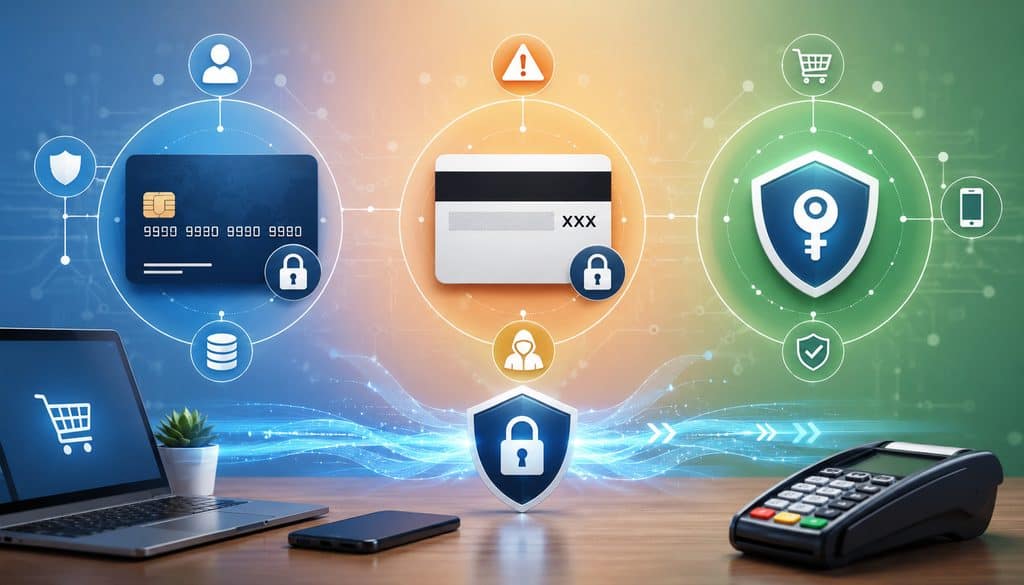
A secure architecture begins with understanding what each value represents.
The primary account number, or PAN, is central cardholder data. Expiration date, cardholder name, and service code can also fall within cardholder-data concepts when stored with the PAN, subject to PCI DSS requirements.
Sensitive authentication data is treated differently. Card verification codes such as CVV2, CVC2, CID, or comparable values are sensitive authentication data.
PCI SSC states that card-verification codes must not be stored after authorization, even when encrypted.
That means CVV should not be retained for:
- Subscription renewals
- Automatic retries
- Future purchases
- Saved-card accounts
- Customer-support convenience
- Fraud investigations
Recurring billing should use appropriately stored credentials or tokenized references, not saved CVV.
A provider token is generally a surrogate identifier referencing credentials in a processor, gateway, or vault. A merchant may store that token and use it to reference the payment method without placing raw PAN in its ordinary application database.
PCI SSC’s tokenization guidance explains that replacing PAN with a token can help reduce the amount of cardholder data within an environment and potentially reduce PCI effort, but tokenization does not eliminate the need for PCI DSS compliance.
Whether tokenized systems can be considered outside scope depends on the implementation and whether PAN can be retrieved from those systems.
For additional introductory context, see this explanation of payment tokenization.
A network token is different from an ordinary gateway token. EMVCo describes EMV payment tokens as substitutes for a PAN that can be constrained to a particular merchant, device, or payment scenario. Network-token lifecycle and portability depend on the ecosystem and contractual implementation rather than simply on the word “token.”
How Hosted Checkout and Direct APIs Affect PCI Scope
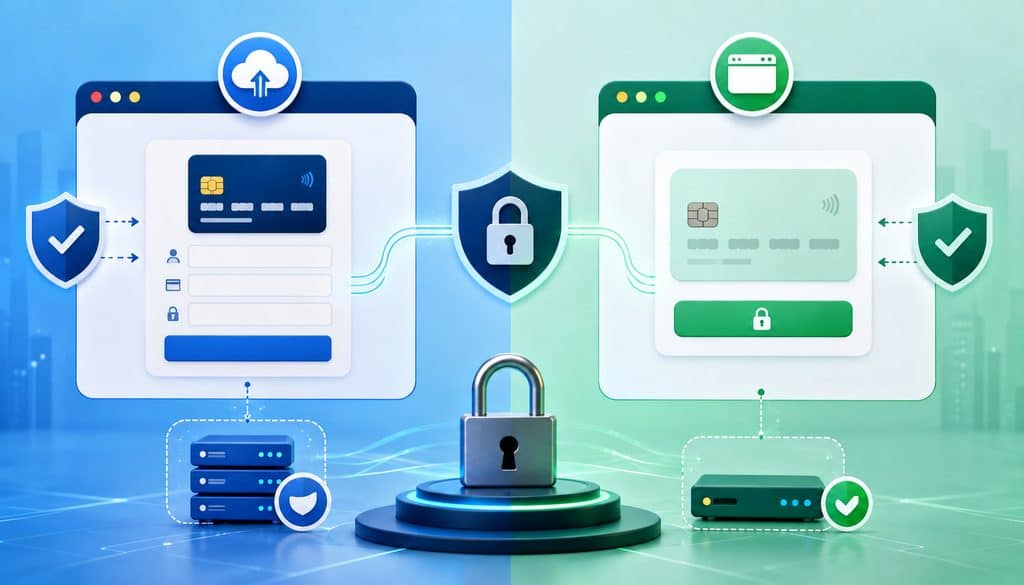
PCI DSS scope is determined by the actual account-data environment and systems that can affect its security, not by a product’s marketing label.
For ecommerce, determine:
- Where account data is entered
- Who supplies the payment-page components
- Whether the merchant receives or transmits account data
- Which merchant systems can affect payment security
- Which third-party service providers participate
- How scripts and redirects are controlled
- Whether card data is stored anywhere
- Which current SAQ eligibility criteria are satisfied
A merchant should review the current PCI Security Standards Council guidance on SAQ eligibility before relying on a questionnaire assumption.
Hosted Checkout and SAQ A
A fully outsourced ecommerce payment architecture may potentially qualify for SAQ A when all applicable eligibility criteria are met.
PCI SSC states that SAQ A applies to qualifying merchants whose account-data functions are completely outsourced to compliant third parties and that do not electronically store, process, or transmit account data in merchant systems. For ecommerce eligibility involving payment-page elements, PCI SSC has specific rules concerning where those elements originate.
Current requirements also demonstrate why “hosted means no PCI” is inaccurate.
PCI SSC clarified that ecommerce merchants completing SAQ A have external vulnerability-scanning obligations for relevant merchant webpages, including merchants that redirect transactions to third-party service providers or embed provider iframes.
For certain embedded payment-page implementations, SAQ A also includes an eligibility criterion requiring confirmation that the site is not susceptible to script attacks affecting the ecommerce system. PCI SSC explains that this particular script criterion applies to embedded provider forms rather than conventional redirect-only scenarios.
In other words, reduced PCI scope still requires active security work.
SAQ A-EP and Ecommerce Environments
SAQ A-EP addresses certain ecommerce environments where the merchant does not electronically store, process, or transmit account data itself but its website affects the security of the payment transaction or integrity of the payment page.
PCI SSC documentation describes SAQ A-EP as applying to qualifying ecommerce merchants that partially outsource payment processing while retaining a website that can affect payment security.
This is precisely why two integrations that both advertise “tokenization” can produce different validation obligations.
For example, a merchant-controlled payment page that posts account data directly from the consumer browser to a provider is structurally different from a provider-hosted iframe whose payment elements originate directly from a PCI DSS-compliant service provider.
Do not determine SAQ A versus SAQ A-EP based on a generic diagram alone. Check every current eligibility criterion with the merchant’s acquirer, payment provider, compliance program, and qualified PCI professional where appropriate.
When Broader PCI Assessment May Apply
Merchants whose environments do not qualify for a reduced SAQ may need a broader assessment method, potentially including SAQ D where applicable.
That does not mean:
Direct API = SAQ D.
An API integration may use provider-hosted fields or client-side tokenization. Another API implementation may route PAN through merchant servers. Those are significantly different architectures.
Start with the data flow and eligibility rules, not the API label.
| Architecture | Does Merchant Server Receive PAN? | Can Merchant Page Affect Payment Security? | Potential PCI Burden | Verify With |
| Redirect hosted page | Typically no when properly implemented | Yes, merchant systems may still affect redirection/security | Often comparatively reduced | PCI SSC, acquirer/provider |
| Hosted iframe | Typically no when provider collects data | Yes | Potentially reduced, criteria dependent | PCI SSC |
| Hosted fields | Typically no when correctly implemented | Often yes | Architecture dependent | PCI SSC |
| Client-side tokenization | Typically no in merchant backend | Often yes | Architecture dependent | PCI SSC |
| Server-side PAN API | Yes | Yes | Generally broader | PCI SSC, QSA/acquirer |
PCI DSS Is More Than Selecting a Questionnaire
A shorter questionnaire is not a substitute for a security program.
Even merchants that outsource payment collection still operate websites, administrator accounts, ecommerce platforms, extensions, APIs, DNS configurations, cloud resources, and third-party scripts that attackers may target.
PCI SSC’s ecommerce guidance emphasizes controls addressing unauthorized payment-page scripts and tampering.
The Council notes that modern ecommerce pages often depend on third-party scripts and that the security objectives of PCI DSS Requirements 6.4.3 and 11.6.1 include controlling authorized scripts, integrity, inventory, and detection of unauthorized changes affecting payment pages.
Consider common website dependencies:
- Tag managers
- Analytics
- Advertising pixels
- Customer-chat tools
- A/B testing scripts
- Consent managers
- Review widgets
- Affiliate technology
- Customer-support tools
- Frontend libraries
A merchant does not need to eliminate these tools automatically. It needs to understand which scripts execute around sensitive checkout flows, whether they are authorized, what they can access, and how changes are governed.
This is especially important with embedded checkout. A card field may technically originate from the payment provider while the overall checkout page still contains merchant and third-party code.
Security responsibilities should also include patching, access control, secure development, vulnerability management, incident response, third-party oversight, and careful change management.
NIST’s Secure Software Development Framework provides a useful broader model for integrating security practices throughout software development rather than treating security as a final pre-launch task.
Checkout Customization: What Control Is Lost or Gained?

Customization is often the primary business argument for choosing a payment API, but merchants should identify exactly which customization they need.
A provider-hosted checkout commonly gives the payment provider more control over:
- Card-entry layout
- Field validation
- Error presentation
- Supported payment methods
- Wallet display
- Authentication transitions
- Some localization behavior
- Accessibility implementation
- Payment-method updates
Providers may allow logos, colors, fonts, custom domains, locale settings, optional fields, and other branding controls. The amount of customization varies substantially.
A direct checkout API can give the merchant much more control over:
- Checkout layout
- Number and order of checkout steps
- Payment-method sequencing
- Express checkout
- Account login integration
- Cart and payment synchronization
- Saved-card selection
- Shipping and payment sequencing
- Localization
- Product experimentation
- Complex purchase workflows
The tradeoff is that every additional merchant-controlled behavior becomes something the merchant must build, test, monitor, secure, and maintain.
There is no reliable universal rule that a direct API converts better than hosted checkout. A sophisticated custom checkout can perform poorly if it is slow, confusing, inaccessible, or unstable. Likewise, a fast and familiar hosted checkout can perform effectively despite giving the merchant less visual control.
A useful related resource is this discussion of reducing false declines without weakening ecommerce fraud controls, because payment performance depends on more than the appearance of the checkout.
Redirect Friction, Embedded Checkout, and Mobile Experience
Redirects can introduce concerns around domain transitions, visual continuity, browser navigation, and perceived trust. Merchants should test the real customer journey rather than assuming customers will dislike any redirect.
Embedded hosted fields can offer a middle ground by letting the customer stay within a merchant-branded checkout while sensitive fields remain provider controlled.
Mobile testing is especially important.
A checkout that looks acceptable on desktop can fail on smaller screens because of keyboard behavior, authentication transitions, modal sizing, scrolling, wallet placement, or error messages.
Native mobile apps require separate architectural review. A browser-hosted ecommerce model should not automatically be copied into an iOS or Android implementation without examining the provider’s supported SDK and payment-data flow.
Accessibility also belongs in the evaluation. Test keyboard navigation, labels, focus behavior, validation messages, screen-reader usability, contrast, and error recovery. Hosted technology may shift implementation responsibility for certain fields to a provider, but the merchant still owns the overall customer journey.
Tokenization, Saved Cards, and Subscription Billing
Tokenization is where hosted checkout and API architectures often converge.
A common pattern is:
Card Data → Provider/Vault → Token → Merchant Application
The merchant stores an opaque token or payment-method identifier instead of raw PAN. That token may then be referenced during future customer-initiated purchases or permitted merchant-initiated transactions.
Saved Cards and Credential-on-File Payments
A saved-card experience needs more than a database column containing a token.
The merchant should design:
- Customer consent
- Customer-to-token mapping
- Masked payment-method display
- Default-method selection
- Replacement and deletion
- Credential lifecycle management
- Expiration and account updates
- Authentication where applicable
- Provider exit and migration handling
Card-network rules also matter.
Visa’s current rules include requirements around stored-credential agreements and appropriate transaction indicators, while Mastercard rules similarly define credential-on-file transactions and related indicators.
The initial customer interaction should therefore be distinguished from later payments.
Initial Customer Interaction → Credential Stored/Tokenized → Future Customer-Initiated or Merchant-Initiated Payment
Do not assume that because a provider offers a “saved card API,” it automatically handles every network-rule, consent, billing, or lifecycle requirement for the merchant.
Hosted Checkout for Subscriptions
Hosted checkout can work well for subscriptions.
The provider can collect the initial credential and return a reusable token, customer object, subscription reference, or other permitted identifier. The merchant can then retain the non-PAN reference while the provider’s vault maintains the underlying credential.
A hosted solution may also provide subscription scheduling, invoices, retries, lifecycle events, account updater capabilities, and customer self-service.
The merchant should verify which features are actually included.
A hosted payment page that merely accepts the first payment does not automatically become a complete recurring-billing platform.
Direct APIs for Complex Billing
A recurring payment API becomes more useful when billing logic is strongly tied to the merchant’s own product.
Examples include:
- Usage-based SaaS billing
- Complex proration
- Multiple subscriptions per account
- Multiple payment methods
- Separate authorization and capture workflows
- Custom invoicing
- Contract-based billing
- Multi-currency account rules
- Specialized retry logic
- Account-level payment orchestration
The API gives the merchant more control over how its billing engine interacts with payment infrastructure.
It also requires strong ownership of state management, webhook processing, reconciliation, testing, and failed-payment handling.
Gateway Tokens Versus Network Tokens
A gateway or processor token normally references a credential stored in that provider’s vault. Portability may be limited because the identifier can be meaningful only inside that provider’s platform.
Network tokens operate within card-network tokenization infrastructure and may have lifecycle capabilities tied to the underlying account. EMVCo’s payment-tokenization framework establishes technical roles and controls for these payment tokens, while individual network implementations determine specific capabilities.
Do not assume network tokens are universally portable between processors.
Before signing a long-term payment agreement, ask:
- Who controls the vault?
- Can stored credentials be migrated securely?
- Are gateway tokens provider-specific?
- Are network tokens supported?
- Who is the token requestor where applicable?
- What happens to subscriptions if the relationship ends?
- Can PAN migration be performed through a PCI-compliant process?
- How long is legacy transaction access retained?
These questions can matter more to long-term operational control than the checkout’s CSS options.
Redirects, APIs, Webhooks, and Payment State
A robust ecommerce integration needs more than a successful checkout screen.
A customer arriving at /thank-you is not sufficient evidence that a transaction reached the intended payment state.
Consider a hosted redirect:
Merchant → Provider → Payment Processing → Merchant Return URL
The browser may never complete the return.
The customer might:
- Close the tab
- Lose connectivity
- Navigate backward
- Experience a timeout
- Complete authentication in a delayed flow
- Leave before the provider redirects
Meanwhile, the provider may still have created, authorized, declined, or otherwise updated the payment.
The correct operational pattern is:
Provider API/Webhook + Server-Side Order State = Payment Truth
The browser experience is useful for customer navigation. It should not be the merchant’s only authoritative payment record.
Webhook Integration
Payment webhooks notify merchant systems of asynchronous payment events.
Depending on the provider, events can include:
- Payment succeeded
- Payment failed
- Authorization completed
- Capture completed
- Refund processed
- Dispute created
- Subscription payment processed
- Payment method updated
This is why:
API Response ≠ Complete Payment Lifecycle
A synchronous API response tells the application what happened at that moment. Later events can alter the state.
Webhook endpoints should defensively address provider-supported signature verification, duplicate delivery, retries, event ordering, safe logging, and authentication requirements.
Webhook processing should also be idempotent.
If an identical event arrives twice, processing it twice should not create two shipments, two invoices, two refunds, or two customer credits.
Idempotency and API Retries
Payment operations are unusually sensitive to network ambiguity.
Imagine the merchant sends a charge request, the provider processes it, but the network connection fails before the merchant receives the response. Blindly sending another charge could create a duplicate transaction.
Where supported, idempotency keys allow equivalent retries to be recognized as the same intended operation.
This technique is valuable for:
- Payment creation
- Capture
- Refund operations
- Subscription actions
- Other provider-supported state-changing API requests
Exact behavior varies by API. Developers should follow the provider’s documentation rather than assuming every gateway implements idempotency identically.
Payment State Machine
Merchants should model payments as states rather than as a Boolean paid=true.
A simplified model is:
Created → Authorized → Captured → Settled → Refunded/Disputed
Not every transaction follows every step, and gateway terminology varies.
For example, some businesses authorize first and capture later after confirming inventory. Others run immediate sale transactions. Partial capture may be supported for particular use cases.
The merchant’s order system should also distinguish:
Order State ≠ Payment State
An order can be awaiting inventory while its payment is authorized. A payment can be refunded while an order remains in the database. A dispute can occur weeks after an order was fulfilled.
Separating these concepts dramatically improves reconciliation and exception handling.
Development, Testing, Authentication, and Fraud Controls
Hosted checkout generally reduces the amount of payment-specific frontend and backend software the merchant needs to build.
A direct API increases control but also increases engineering ownership.
| Workstream | Hosted Checkout | Direct API |
| Payment form | Largely provider managed | Merchant/provider combination |
| Field validation | Often provider managed | More merchant controlled |
| Tokenization | Commonly built in | Merchant must integrate correctly |
| Backend payment logic | Lower to moderate | Usually higher |
| Webhooks | Still important | Usually essential |
| Error handling | Shared/provider dependent | Greater merchant ownership |
| PCI/security work | Often comparatively reduced | Architecture dependent; potentially greater |
| Recurring billing | Provider dependent | Highly customizable |
| Maintenance | Usually lower | Usually higher |
| Regression testing | Required | Usually broader |
Hosted checkout can reduce responsibility for changes to card-entry fields, payment-method presentation, some authentication interfaces, and provider-managed validation.
It does not eliminate integration maintenance.
The merchant still needs to test:
- Redirect construction
- Return URLs
- Order-state reconciliation
- Webhook processing
- Refund workflows
- Stored credentials
- Authentication flows
- Payment failures
- Provider configuration
- Platform upgrades
Direct API integrations add API-version management, SDK updates, browser compatibility, security patches, webhook-schema handling, new payment methods, and regression testing.
Ask providers about their:
- API deprecation policy
- Version-support window
- Migration notices
- Changelog
- Sandbox
- Test credentials
- Webhook testing tools
- Backward-compatibility policy
NIST’s secure-development guidance supports integrating security into the development lifecycle rather than bolting it on after implementation.
Checkout Testing
A payment integration should be tested against realistic failure states using only provider-approved sandbox environments and test credentials.
At minimum, test:
- Successful payment
- Declined payment
- Gateway timeout
- Duplicate submission
- Full refund
- Partial refund where supported
- Wallet payment
- Authentication flow where applicable
- Webhook retry
- Duplicate webhook
- Abandoned redirect
- Delayed payment-state update
- Browser refresh
- Inventory or order failure after authorization
- Provider outage behavior
The goal is not merely to prove that the happy path works.
The merchant should know what happens when the customer, browser, merchant application, provider, issuer, or network does not behave as expected.
3-D Secure, AVS, and CVV
EMV 3-D Secure enables additional information to be exchanged among merchants, issuers, and the payment ecosystem to support cardholder authentication. Depending on risk and issuer decisions, a transaction may proceed through a lower-friction flow or may require additional customer interaction. EMVCo maintains the underlying 3DS specifications.
Hosted checkout may allow the provider to manage much of the 3DS interface.
API-controlled integrations may give the merchant more orchestration options but can require deeper implementation of browser or app transitions, challenge handling, and transaction state.
AVS and card-verification-code results can also serve as card-not-present verification signals where supported. They are not guarantees that a transaction is legitimate.
For businesses selling in regions where Strong Customer Authentication affects payment design, this overview of SCA and ecommerce authentication provides additional background, while current provider and regulatory requirements should always be checked for the merchant’s specific markets.
Subscriptions, Saved Cards, and High-Volume Ecommerce: Which Model Fits?
Neither subscriptions nor transaction volume automatically determines the integration model.
A subscription company can run successfully using a hosted payment page if the provider captures the initial credential, tokenizes it, and supplies the recurring-billing features the company needs.
Likewise, a high-volume ecommerce merchant does not necessarily need to collect PAN itself.
Volume should be considered alongside:
- Engineering maturity
- Checkout complexity
- Billing model
- Number of payment methods
- Geographic footprint
- Fraud strategy
- Authorization/capture requirements
- Routing requirements
- Observability
- Reliability requirements
- Operational staffing
- Reconciliation complexity
A high-volume retailer with a simple purchase flow may benefit from a robust hosted checkout because outsourcing payment-entry complexity can improve maintainability.
A large platform with multiple payment providers, customized fraud decisions, complex fulfillment, partial captures, specialized billing, and sophisticated payment routing may benefit more from API orchestration.
The defining issue is complexity, not sales volume.
Refunds, Disputes, Settlement, and Reconciliation Continue After Checkout
Checkout is only the beginning of the payment lifecycle.
Even a merchant using a completely provider-hosted payment page still needs reliable processes for refunds, disputes, settlement, funding, and accounting.
A refund flow may use:
- A provider dashboard
- A refund API
- An ecommerce-platform integration
- Internal back-office tooling
Hosted checkout generally refers to the initial collection experience, not every post-purchase operation.
Direct APIs can make it easier to build refund actions directly into merchant software. That can be valuable for customer-service teams or automated order systems, but permissions and audit controls become important.
Partial refunds should be handled only where the provider and payment state support them.
Disputes can arise long after checkout and require reliable identifiers, documentation, reporting, portal/API access, and event handling.
Finance teams should preserve the chain:
Checkout → Provider Transaction → Settlement → Bank Deposit → Accounting
Useful identifiers include:
Merchant Order ID → Provider Payment ID → Customer/Token ID → Refund or Dispute ID → Settlement/Funding ID
Not every provider uses all of those identifiers, so merchants should map the available ones during integration design.
PCI scope reduction has little to do with eliminating reconciliation work. Finance still needs to determine why an order for $120, a refund of $20, provider fees, and a later settlement resulted in the actual amount received at the bank.
Availability, Resilience, Monitoring, and Security Responsibilities
Hosted checkout and APIs fail differently.
With hosted checkout, the merchant may depend heavily on the payment provider’s hosted-page availability, DNS, redirect flow, tokenization infrastructure, and downstream processing stack.
With direct APIs, the merchant may additionally need to operate resilient application logic for:
- Timeouts
- Retries
- Idempotency
- Queueing
- Circuit breaking
- Dependency failures
- Webhook delays
- Partial service degradation
A provider status page is useful but insufficient.
Merchant-side monitoring should track:
- Checkout errors
- Tokenization failures
- API latency
- API error rates
- Authorization outcomes
- Webhook failures
- Webhook processing delays
- Authentication failures
- Refund errors
- Provider outages
Do not invent a universal uptime threshold. Define service objectives from the merchant’s business requirements and provider agreement.
Security Responsibility Matrix
| Security Responsibility | Hosted Checkout | Direct API | Shared/Depends |
| Merchant website security | Merchant | Merchant | |
| Provider payment infrastructure | Provider | ||
| Payment-entry form | Often provider | Merchant or provider depending on architecture | Yes |
| API credentials | Merchant where used | Merchant | |
| Webhook verification | Merchant | Merchant | |
| Access control | Merchant for merchant systems | Merchant for merchant systems | Provider controls its platform |
| Token vault | Usually provider | Provider or merchant-selected vault | Architecture dependent |
| Payment-page scripts | Architecture dependent | Architecture dependent | Yes |
| Application security | Merchant | Merchant | |
| Processor/acquirer infrastructure | Provider ecosystem |
API credentials should be stored server-side, scoped to the least privileges available, separated between test and production, rotated according to policy, and kept out of browser source code.
Logs deserve equal attention.
Applications should never intentionally log:
- Full PAN
- CVV
- Magnetic-stripe data
- PIN data or PIN blocks
- Unnecessary sensitive account data
Useful operational logging can instead rely on:
- Merchant order ID
- Provider payment ID
- Token/payment-method ID
- Masked last four digits where appropriate
- Payment status
- Error category
- Correlation ID
This provides observability without treating sensitive payment data as ordinary debugging information.
Total Cost and Vendor Lock-In
Transaction pricing is only one component of the cost of an ecommerce payment integration.
A more realistic formula is:
Total Integration Cost = Development + Security/PCI + Maintenance + Provider Fees + Support + Opportunity Cost
Hosted checkout may reduce initial and ongoing engineering work but create tradeoffs such as:
- Provider branding constraints
- Less checkout experimentation
- Provider-specific customer objects
- Provider-specific tokens
- Platform dependence
- Feature limitations
Direct APIs may introduce:
- Frontend engineering
- Backend payment services
- Security engineering
- Expanded PCI controls
- Test automation
- Monitoring
- On-call maintenance
- API upgrades
- More complex incident response
A technically “free” API can therefore be far more expensive operationally than a provider-hosted solution.
Vendor lock-in deserves separate analysis.
Ask what would happen if the merchant changed gateways in the future.
Important questions include:
- Can stored credentials be exported securely?
- Can PAN migration be arranged between PCI-compliant parties?
- Are tokens meaningful outside the existing provider?
- Who owns recurring-billing schedules?
- Can subscription state be exported?
- Can customer and transaction data be retrieved?
- How long are historical transactions retained?
- Can refunds still be processed after migration?
- How much application code is provider specific?
Long-term payment control is not equivalent to raw-card-data control.
A merchant can preserve strategic flexibility through portable architecture, clean ID mapping, contractual migration rights, and abstraction of provider-specific APIs without ever deciding that it needs to store card numbers itself.
Hosted Checkout vs API Decision Matrix
For many businesses, the most useful comparison involves three models rather than two.
| Requirement | Hosted Checkout | Hosted Fields/Hybrid | Direct API |
| Small PCI footprint priority | Strong candidate | Strong candidate, architecture dependent | Depends heavily on data flow |
| Maximum UX control | Limited to moderate | High | Very high |
| Fast implementation | Strong | Moderate | Usually lower |
| Small engineering team | Strong candidate | Possible | More demanding |
| Complex subscriptions | Provider dependent | Strong when paired with APIs | Strong |
| Saved cards | Provider dependent | Strong when tokenization supported | Strong |
| Custom fraud stack | Limited to moderate | High | High |
| High-volume orchestration | Possible | Strong | Strong |
| Multi-provider strategy | More difficult | Possible | Often most flexible |
| Lowest raw-PAN exposure | Often strong | Often strong | Only if designed for tokenized/provider collection |
When Hosted Checkout Usually Fits Best
Hosted checkout is often appropriate when a merchant prioritizes:
- Faster implementation
- Reduced raw-card-data exposure
- Lower development burden
- Provider-managed payment UI
- Limited payment engineering resources
- Straightforward purchases
- Standard subscriptions supported by the provider
The tradeoff is lower control over payment-entry details and potentially greater dependence on the provider’s checkout capabilities.
When Direct API Usually Fits Best
A direct payment API may fit organizations requiring:
- Deep checkout customization
- Complex billing logic
- Sophisticated order/payment state management
- Multiple captures or specialized payment operations
- Custom fraud orchestration
- Multiple providers
- Advanced observability
- Extensive internal payment infrastructure
The merchant must be prepared to secure and maintain that architecture.
A direct API is most defensible when the business can identify specific requirements that a lower-complexity architecture cannot meet.
When Hosted Fields Are the Middle Ground
Hosted fields deserve serious consideration because they can separate customer-experience control from sensitive-card-data control.
A common design is:
Provider-Hosted Sensitive Fields + Merchant-Controlled Checkout + Tokenized API Calls
This can support branded checkout, customer accounts, saved payment methods, custom order logic, API-driven operations, and provider tokenization while avoiding deliberate PAN handling by ordinary merchant backend services.
Actual PCI implications still need to be validated against the precise implementation and current eligibility requirements.
Questions to Ask Before Selecting an Ecommerce Payment Integration
A good provider evaluation should force architectural details into the open.
Ask the payment provider:
- Where exactly does the customer enter PAN?
- Does our server ever receive PAN?
- Which systems receive expiration date and cardholder data?
- Which current PCI SAQ may apply?
- Which eligibility criteria must our implementation meet?
- Are sensitive payment fields hosted directly by you?
- Can merchant JavaScript interact with those fields?
- How is tokenization performed?
- Who owns and operates the token vault?
- Are provider tokens portable?
- Are network tokens supported?
- How do saved cards work?
- How are stored-credential indicators handled?
- How are recurring payments supported?
- Is account updater functionality available?
- Are webhooks signed?
- How should duplicates and event ordering be handled?
- Is API idempotency supported?
- How should redirects be reconciled with server-side status?
- Which API versions are supported?
- What is the deprecation policy?
- How are refunds and disputes handled?
- Which settlement and funding IDs are available?
- What happens to stored credentials if we leave?
Ask the development team:
- Do we actually need raw PAN control?
- Which checkout elements genuinely require customization?
- Can hosted fields satisfy those requirements?
- Can we operate payment API infrastructure securely?
- Who owns webhook reliability?
- How will API secrets be managed?
- How will ambiguous payment states be reconciled?
- How will checkout changes be regression tested?
- Who maintains the integration over time?
- How will provider outages affect orders?
Ask the security and PCI team:
- What account data enters our environment?
- Which systems are in PCI scope?
- Which current SAQ eligibility criteria apply?
- Can account-data exposure be reduced further?
- How are payment-page scripts governed?
- How are third-party providers documented?
- How are vulnerabilities monitored?
- How would we detect payment-page tampering?
- What is the incident-response process?
Common Hosted Checkout vs API Mistakes
A surprising number of ecommerce payment problems begin with an architectural assumption rather than a coding error.
Common mistakes include:
- Assuming hosted checkout means zero PCI obligations
- Assuming every iframe has the same PCI treatment
- Assuming every payment API sends PAN through the merchant backend
- Choosing direct API solely for visual customization
- Storing CVV for recurring transactions
- Treating a browser return URL as definitive payment confirmation
- Ignoring asynchronous webhooks
- Processing duplicate webhook events twice
- Retrying payment requests without appropriate idempotency
- Logging full card data
- Treating tokenization as a complete security program
- Ignoring token portability
- Failing to plan for provider outages
- Choosing an API the team cannot maintain securely
- Choosing hosted checkout that cannot support required billing logic
- Hard-coding payment state into order state
- Ignoring refund and dispute workflows during implementation
- Relying on outdated SAQ guidance
The recurring pattern is unnecessary complexity.
If a provider-hosted form can safely support the merchant’s checkout and billing requirements, controlling raw account data rarely provides business value by itself.
Conversely, choosing a restrictive hosted page simply to minimize initial engineering work can become expensive if the business later requires capabilities that the integration cannot support.
Architecture should therefore be evaluated against both present requirements and realistic future needs.
Hosted Checkout vs API Implementation Checklist
Use this checklist before production launch.
| Area | Verified? |
| Payment data flow documented | ☐ |
| PAN exposure known | ☐ |
| PCI scope reviewed | ☐ |
| Current SAQ eligibility verified | ☐ |
| Checkout customization requirements defined | ☐ |
| Tokenization design documented | ☐ |
| Token portability reviewed | ☐ |
| Saved-card workflow tested | ☐ |
| Recurring-payment workflow tested | ☐ |
| Webhook signatures verified | ☐ |
| Duplicate webhooks handled | ☐ |
| Redirect failure handling tested | ☐ |
| Idempotency implemented where supported | ☐ |
| Error handling tested | ☐ |
| Fraud controls reviewed | ☐ |
| 3DS flow tested where applicable | ☐ |
| API secrets protected | ☐ |
| Sensitive logging prevented | ☐ |
| Refunds tested | ☐ |
| Partial refunds tested where supported | ☐ |
| Settlement/reconciliation mapping documented | ☐ |
| Monitoring implemented | ☐ |
| Provider outage procedure tested | ☐ |
| Accessibility reviewed | ☐ |
| Mobile checkout tested | ☐ |
| Provider exit/migration plan documented | ☐ |
A checklist should not become a substitute for architecture review. Its value is forcing teams to verify assumptions before customers and real account data enter the system.
Frequently Asked Questions
What is the difference between hosted checkout and a payment API?
Hosted checkout moves some or all payment-entry functionality to a payment provider, while a payment API gives the merchant application more programmatic control over payment operations.
The distinction does not reveal where PAN travels. An API can use provider-hosted fields or client-side tokenization and keep raw card numbers away from the merchant backend.
Does hosted checkout reduce PCI scope?
It often can. A properly designed hosted payment page can outsource sensitive card entry and processing to a compliant third-party provider, potentially reducing the merchant’s PCI scope.
Actual scope and SAQ eligibility depend on the complete architecture, current PCI SSC criteria, the origin of payment-page elements, and whether merchant systems receive or can affect the security of account data.
Does a hosted payment page eliminate PCI compliance?
No. Outsourcing payment collection does not remove every merchant obligation. PCI SSC’s current SAQ A guidance includes requirements that remain relevant to qualifying ecommerce merchants, including external vulnerability scanning of relevant ecommerce webpages. Merchants must validate their actual responsibilities with their compliance-enforcing entity.
Does a direct payment API require SAQ D?
Not automatically. One direct API implementation may route raw PAN through merchant servers, while another may use hosted fields or provider-side client tokenization. Those architectures can have very different PCI implications. Determine where account data flows and then evaluate current SAQ eligibility rather than assigning SAQ D solely because an API is involved.
What is the difference between SAQ A and SAQ A-EP?
Conceptually, SAQ A applies to qualifying merchants that outsource applicable account-data functions to compliant third parties, while SAQ A-EP addresses certain ecommerce environments where the merchant’s website can affect payment security even though merchant systems do not electronically store, process, or transmit account data. Every current eligibility criterion must be checked before selecting either questionnaire.
Can I customize a hosted payment page?
Usually, but the degree varies. Providers may support logos, colors, fonts, localization, custom domains, optional fields, payment-method configuration, and other branding. If the checkout requires highly specialized layouts, experimentation, or payment sequencing, hosted fields or a more API-controlled architecture may provide additional flexibility.
What are hosted payment fields?
Hosted fields are sensitive payment inputs supplied by a payment provider while the surrounding checkout remains under merchant control. Card information can be sent directly to the provider, which returns a token for merchant API operations. Hosted fields can provide a useful compromise between checkout customization and reducing raw-card-data exposure.
Can a merchant use an API without handling raw card numbers?
Yes. Client-side tokenization and provider-hosted payment fields can send card information directly from the customer’s browser to the provider. The merchant backend receives a token or payment-method reference instead of PAN and then uses its payment API integration to authorize, capture, refund, or otherwise manage transactions.
How does tokenization reduce payment-data exposure?
Tokenization replaces PAN with a surrogate value that can reference the underlying credential through the tokenization system. This can keep raw PAN out of ordinary merchant applications and databases.
PCI SSC cautions, however, that tokenization can reduce scope only when the implementation supports that conclusion; using tokens does not automatically create PCI compliance.
How do webhooks work with hosted checkout?
After a hosted checkout creates or changes a payment, the provider can send server-to-server webhook events to the merchant. These events help the merchant update orders even when the customer’s browser never returns successfully. Webhook processing should follow provider guidance for authentication or signatures, retries, duplicate events, and idempotent processing.
Why should merchants not rely only on the checkout return URL?
The customer can close the browser, lose connectivity, or fail to complete the redirect even though payment processing occurred. The merchant should verify payment state through authoritative provider APIs and/or authenticated webhook events and maintain server-side order state instead of treating the appearance of a thank-you page as proof of final payment success.
Which checkout model is better for saved cards?
Either can work. The important capabilities are secure tokenization, customer-to-token mapping, appropriate customer consent, credential lifecycle management, update and deletion workflows, network-rule handling, and a viable migration strategy. Hosted checkout can collect the initial credential while an API later references its token.
Which payment integration is better for subscriptions?
A hosted checkout may be ideal for straightforward subscriptions when the provider supplies tokenization and recurring-billing tools.
Direct APIs are often useful when a merchant needs usage-based billing, complex proration, custom retry logic, multiple payment methods, or extensive synchronization between product and payment states. The billing requirements should determine the architecture.
Is a hosted checkout suitable for high-volume ecommerce?
Yes. Transaction volume alone does not require a direct API. High-volume merchants with relatively simple checkout requirements can use robust hosted payment infrastructure effectively.
API-controlled architecture becomes more attractive when high volume is accompanied by complex routing, fraud orchestration, payment methods, authorization/capture logic, or operational requirements.
How should a merchant choose between hosted checkout, hosted fields, and a direct API?
Start by identifying the checkout features that are genuinely required, then draw where PAN travels. Choose the lowest-complexity architecture that satisfies customer-experience, subscription, fraud, reporting, and operational needs while minimizing sensitive account-data exposure. Verify the resulting PCI scope and current SAQ eligibility before implementation rather than after launch.
Conclusion
The hosted checkout vs API decision should not begin with a preference for redirects or custom forms. It should begin with payment-data flow.
A fully hosted redirect can move sensitive payment collection to a provider, reduce development work, and potentially reduce PCI scope. It may be the best fit for merchants that need a dependable ecommerce payment integration without building extensive payment infrastructure.
Direct APIs provide greater control over checkout behavior, payment state, subscriptions, saved cards, fraud tools, authorization and capture, and operational workflows. But the term “API” says nothing by itself about PCI scope.
An API backed by provider-hosted fields or browser-to-provider tokenization is materially different from one that routes raw PAN through merchant servers.
For many merchants, the most balanced architecture is neither extreme:
Merchant-Controlled Checkout + Provider-Hosted Sensitive Fields + Tokenization + Server-Side Payment APIs + Verified Webhooks
That model can preserve much of the customer-experience and application control a development team wants while reducing the need for ordinary merchant systems to handle raw card data.
The final decision should answer six questions clearly:
- What payment data touches the merchant environment?
- What PCI scope and validation obligations follow from that exact architecture?
- Which checkout elements genuinely need merchant control?
- How will tokens, redirects, APIs, and webhooks establish authoritative payment state?
- Can the organization securely develop, test, monitor, and maintain the integration?
- Will the architecture support saved cards, subscriptions, migration, and operational requirements over the long term?
When those answers are documented, the choice becomes much easier.
Reducing PCI scope is not about finding a label that sounds compliant. It is about deliberately minimizing sensitive account-data exposure while preserving the payment capabilities the business needs.
Payment-security and PCI information is provided for general informational purposes and is not a substitute for an assessment of a merchant’s specific environment. PCI DSS requirements, Self-Assessment Questionnaire eligibility, card-network rules, and provider implementations can change.
Merchants should confirm their actual card-data flow, current SAQ eligibility, validation obligations, and provider responsibilities with their acquiring/payment providers and qualified PCI professionals before relying on a particular architecture.